
The focus of this blog is to present an overview of the new programming techniques in ABAP after the introduction of HANA database. The focus will be towards providing a guideline on why and how an ABAP developer should start transitioning its code to use the new coding technique’s.
Here the target audience would be ABAP developers who are looking forward to getting a basic understanding of ABAP on HANA programming and to understand why to opt for these new features..
Code to Data Paradigm, OpenSQL, CDS Views, AMDPs..
SAP ABAP has been rapidly evolving over the years. With the introduction of S/4HANA, it went to graduate to become a far more impressive and productive language. If you ask me how ABAP has improved then the answer is "Code-To-Data" Paradigm.
The traditional approach involves bringing data from database to our presentation server, doing the data intensive calculations & filtering and then presenting the filtered data to a user.
The new HANA approach is to push our code to the database layer where all the data resides, do the calculations at database layer and bring only the relevant records to
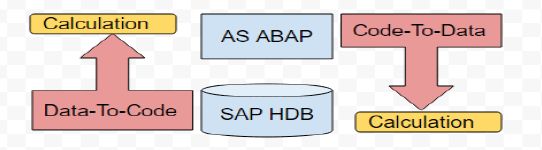
Because of C2D paradigm, the delay caused due to the latency of bringing large volumes of data to presentation layer is removed drastically resulting in high performance even with very large datasets.
To better understand this let me proceed using a basic scenario that any ABAP developer can easily relate to:
Example Scenario: An ALV report that returns the master data of “ALL” vendors and their addresses for vendors that are active, not marked for central deletion, not marked for deletion under “ALL” company code, not marked for deletion under “ALL” purchasing organization.
In this scenario, the performance would suffer because of fetching data for all vendors, for all company codes & for all Purchasing Organization. The resulting report will require a background run and the traditional ABAP report flow ,in this case, would fetch data as follows:
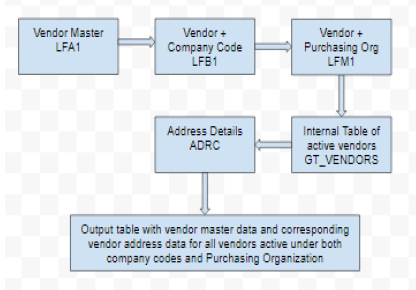
Here the presentation layer would interact with a couple of times if no joins are used under select statement. Moreover using joins to fetch data from these tables would also be very slow because of large volumes of vendor data in the system. So how must I improve the performance here?
Answer
Let us visit each of the above features that were introduced with HANA DB.
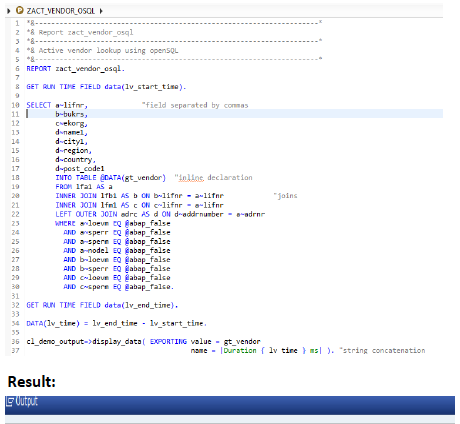
With OpenSQL programming, you can write openSQL syntax in your ABAP code. The syntax for OpenSQL differs from that of ABAP, for example, the fields in select statement are comma separated, all the host variables are escaped using ‘@’ sign, the concatenation can be done in a single statement using ‘| |’ and so on and so forth.
The above scenario will be written as follows:
Result:
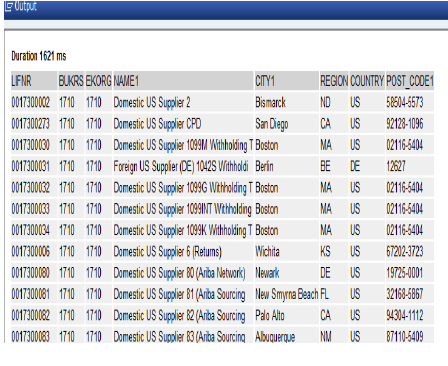
Here you can see that report ran for 1621 ms and returned us the desired results.
This is a very basic example that I took but in real time scenarios where you may be doing some aggregations, or you may be to translating some data during selection, or you may be grouping your result set based on some fields then the OpenSQL really does magic.
SAP has introduced a large number of syntax that can be utilized in the code to improve its performance. To start with you can find very descriptive examples and code snippets in the ABAP glossary itself.
SAP introduced a new data modeling infrastructure known as core data services or CDS. With CDS, data models are defined and consumed on database server rather than on application server. As a result, the table result view is created at the database level. CDS are completely compatible with openSQL and can be written using ABAP development tools like Eclipse Oxygen. These can be consumed by reports and AMDPs as well.
The above code will be created as a data definition in Eclipse and defined as follows:
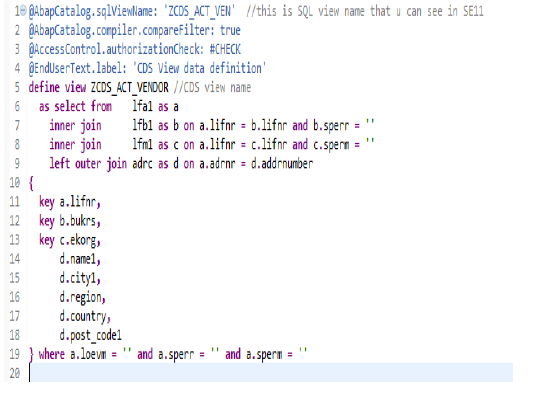
Result
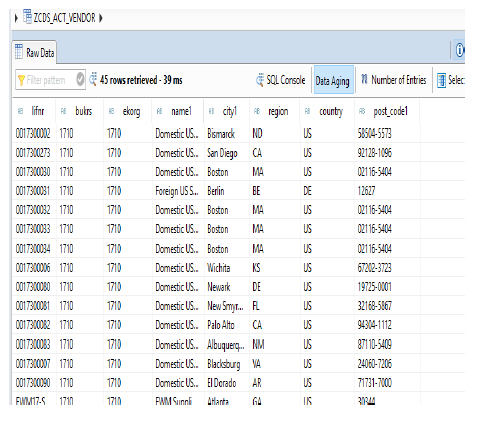
The CDS view returned the result in 39ms. Awesome? Yes, it is.
Now CDS views could also be created with parameters or with associations. You may choose to create a CDS with parameters if you have a fixed result set and some input parameters to pass.
You could also create a CDS with the association for a similar scenario if you have many tables to address in the view and if you want to keep the result set flexible.
AMDPs, as the name says, are database procedures that run on the database directly and are written directly in ABAP. AMDPs are written using AMDP classes. Below is an example using the above scenario of how to create an AMDP class. The interface “IF_AMDP_MARKER_HDB” distinguishes an AMDP class from other classes.
Class definition
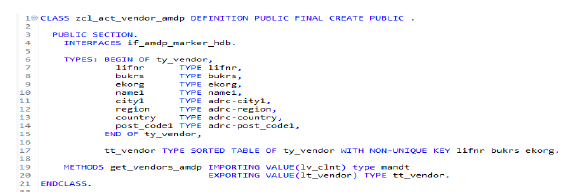
Similarly, an AMDP class implementation will have methods defined with a syntax “BY DATABASE PROCEDURE FOR
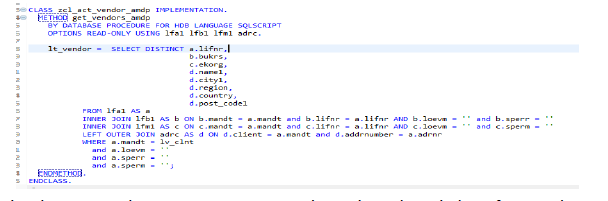
This AMDP class can then be consumed in an ABAP program to achieve the code push down functionality.
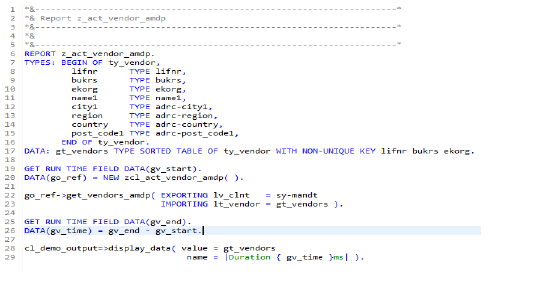
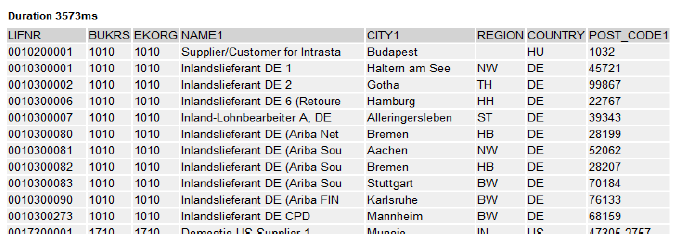
Result:
Digital enable organizations to build new supplier/partner interaction models and redesign logistics and inventory management
A question that would arise in any developers mind would be how to make a choice amongst the three programming techniques.
In the above example, you can see that the performance was CDS > OpenSQL > AMDP. Does that mean for the above scenario the best choice is to create a CDS? Not exactly!
If I do not reuse the CDS view then openSQL could be an equally effective choice.
Also, note that CDS views and AMDP can only be created using ABAP Development Tools like Eclipse Oxygen. Refer the following link to understand how to get eclipse on your system:
https://tools.hana.ondemand.com/#abapThere are no rules that can be adhered to when choosing from the above three programming techniques. It completely depends on the requirement and on what and how data needs to be handled. However, the points below can give an idea on how to proceed to make the most productive choice.
Choose Open SQL when:
Choose CDS when:
Choose Choose AMDPs when:
This blog was to give you a kick start on what HANA has to offer and what you can do with the new techniques. My advice to any beginner would be to get your hands on a system and just try.